For many years, cloud computing has been the backbone of modern digital systems. Whether it is storing data, running applications, hosting APIs, or analysing large datasets, cloud platforms like AWS, Azure, and Google Cloud have helped businesses scale quickly without managing heavy physical infrastructure.
But when it comes to real-time applications, cloud is not always enough.
Think about a self-driving vehicle, a factory robot, a smart traffic signal, a hospital monitoring device, or an AI-powered drone. These systems cannot always wait for data to travel from the device to a far cloud data centre, get processed, and then come back with a response. Even a delay of a few milliseconds can create a serious impact.
This is where Edge Computing comes in.
Edge computing brings computation closer to where the data is actually generated, like sensors, machines, cameras, gateways, and IoT devices. Instead of sending every small piece of data to the cloud, the system processes important data locally and sends only required insights to the cloud. This makes applications faster, more reliable, and more suitable for real-time decision-making.
What is Edge Computing?
Edge computing is a distributed computing approach where data processing happens near the source of data instead of depending completely on a central cloud server. In simple terms,
Cloud Computing:
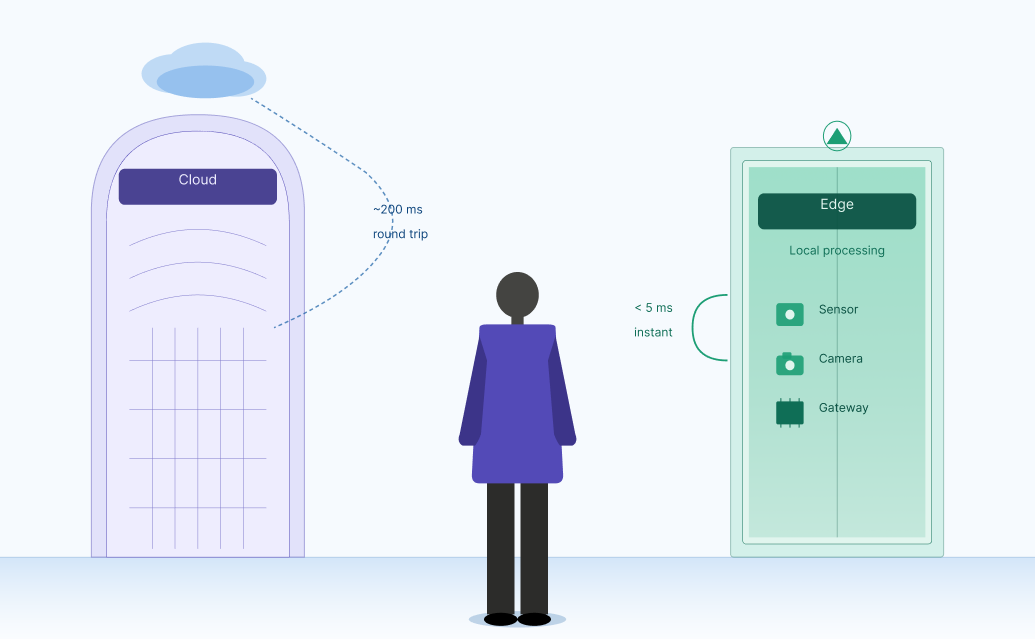
Device → Internet → Cloud Data Centre → Processing → Response back to device
Edge Computing:
Device → Local Edge Gateway / Edge Server → Immediate Processing → Cloud only when needed
For example, in a smart factory, thousands of sensors continuously generate temperature, vibration, pressure, and machine health data. If every reading is sent to the cloud, it can increase latency, bandwidth cost, and dependency on internet connectivity. With edge computing, the factory can process this data locally and only send important summaries, alerts, or long-term analytics data to the cloud.
Why Cloud Struggles in Real-Time Applications
Cloud computing is powerful, but real-time applications have different needs. They need instant responses, stable connectivity, and sometimes local decision-making even when the internet is weak or unavailable.
1. Latency Problems
Latency means delay. In normal web applications, a delay of 200–500 milliseconds may still be acceptable. But in real-time systems, even a small delay can be risky.
For example:
- A self-driving car must detect obstacles instantly.
- A drone must identify threats during live surveillance.
- A smart medical device must alert doctors immediately.
- A robotic arm in manufacturing must stop instantly if it detects danger.
If these systems depend only on cloud processing, data must travel to a remote data centre and come back. This round trip can create delays.
2. Internet Dependency
Cloud-first systems depend heavily on a stable internet. But in real-world IoT environments, connectivity is not always perfect.
Factories, mines, ships, farms, border areas, warehouses, and remote healthcare units may face weak or intermittent network connections. If the cloud connection fails, a fully cloud-dependent system may stop working properly. Edge computing solves this by allowing devices to continue working locally.
3. High Bandwidth Cost
IoT devices generate massive amounts of data. Cameras, sensors, drones, industrial machines, and connected vehicles can create continuous streams of information.
Sending all of this data to the cloud is not always practical. It increases bandwidth usage, cloud storage costs, and network load.
With edge computing, raw data can be filtered locally. Only useful events, summaries, or alerts are sent to the cloud. This reduces unnecessary data movement and improves efficiency.
4. Privacy and Compliance Concerns
Some data is too sensitive to be sent directly to the cloud in raw form. Healthcare data, financial transactions, surveillance footage, biometric data, and industrial operational data may require strict privacy controls.
Edge computing allows sensitive data to be processed locally. The cloud can receive only anonymised, filtered, or aggregated data. This helps organizations improve privacy and reduce compliance risks.
How Edge Computing Works with IoT
IoT systems include devices that collect data from the physical world. These can be sensors, cameras, meters, drones, machines, vehicles, or medical equipment. A typical edge-IoT architecture looks like this:
- IoT Devices / Sensors: Collect real-world data like temperature, motion, pressure, video, GPS, or sound.
- Edge Gateway / Edge Server: Processes data locally, applies rules, runs AI models, filters noise, and makes quick decisions.
- Cloud Platform: Stores long-term data, trains AI models, manages devices, provides dashboards, and performs deeper analytics.
- User Applications: Displays alerts, reports, monitoring dashboards, and control options.
This does not mean the cloud is removed completely. Instead, cloud and edge work together. Edge handles immediate decisions, while cloud handles large-scale storage, model training, centralized management, and business reporting.
This is very similar to how modern serverless or cloud-native systems are designed: cloud services still provide scalability, monitoring, storage, and long-term analytics, while the architecture removes unnecessary infrastructure burden from developers.
Real-World Use Cases of Edge Computing
1. Smart Manufacturing
In manufacturing, machines generate continuous data from sensors. Edge computing helps detect machine faults, overheating, unusual vibration, or production defects in real time.
Instead of waiting for cloud analytics, edge systems can instantly stop a machine, notify engineers, or adjust production settings. This reduces downtime and protects expensive equipment.
2. Autonomous Vehicles
Self-driving cars cannot depend only on cloud decisions. They need to process camera feeds, LiDAR data, radar input, and GPS signals instantly.
Edge computing allows vehicles to make real-time decisions locally, such as braking, steering, lane detection, and obstacle avoidance.
3. Healthcare Monitoring
In healthcare, real-time patient monitoring is critical. Wearable devices, ICU monitors, and remote health sensors can detect abnormal heart rate, oxygen drop, or other emergencies.
With edge computing, alerts can be triggered instantly without waiting for cloud processing. The cloud can still store patient history and generate long-term reports.
4. Smart Cities
Smart traffic lights, surveillance cameras, parking systems, and pollution sensors generate real-time urban data.
Edge computing allows traffic lights to adjust based on congestion, cameras to detect incidents locally, and city systems to respond faster without sending every video stream to the cloud.
5. AI-Powered Drones
Drones used for surveillance, delivery, agriculture, or inspection need fast local decision-making. If a drone depends only on the cloud, network delay can affect object tracking, obstacle detection, or emergency response.
Why Edge is “Replacing” Cloud in Real-Time Workloads
The title says edge computing is replacing cloud, but the more accurate meaning is: Edge is replacing cloud for immediate real-time processing, not for everything.
Cloud is still best suited for long-term and centralized workloads. It is mainly useful for storing large amounts of data, managing central dashboards, training AI models, performing historical analytics, hosting applications, generating large-scale reports, and maintaining backup or disaster recovery systems. These tasks do not always need instant response, so cloud platforms can handle them efficiently with strong scalability and storage capacity.
On the other hand, edge computing is better for time-sensitive and real-time operations. It is useful when applications need instant decision-making, low-latency response, offline operation, local AI inference, real-time data filtering, and privacy-sensitive data handling. Edge computing also helps reduce cloud bandwidth usage because unnecessary raw data does not need to travel to the cloud every time.
So, the future is not only cloud or only edge. The future is cloud + edge together, where each layer does what it is best at.
Benefits of Edge Computing in Real-Time Applications
1. Faster Response Time
Because data is processed closer to the device, response time is much faster. This is the biggest reason edge computing is becoming popular in IoT and real-time systems.
2. Better Reliability
Even if the internet connection is unstable, edge systems can continue working locally. This is very useful in industrial, healthcare, defence, logistics, and remote-area applications.
3. Reduced Cloud Cost
By filtering data locally, organizations send less data to the cloud. This reduces bandwidth, storage, and processing costs.
4. Improved Security and Privacy
Sensitive data can remain local. Only necessary insights are sent to the cloud, which reduces exposure risk.
5. Real-Time AI Inference
AI models can run directly on edge devices or local gateways. This is useful for object detection, anomaly detection, predictive maintenance, and video analytics.
Challenges of Edge Computing
Edge computing has strong benefits, but it also has some challenges that should be planned carefully.
1. Device Management Complexity
Managing thousands of edge devices is not easy. Devices need software updates, security patches, monitoring, and configuration management.
2. Security at the Edge
Edge devices are often physically distributed. If someone gains access to a device, it can become a security risk. Strong authentication, encryption, and secure boot mechanisms are required.
3. Limited Hardware Resources
Edge devices may not have the same compute power as cloud servers. AI models may need to be optimized or compressed to run efficiently.
4. Data Synchronization
When edge devices process data locally, the system must sync important information with the cloud later. If this is not designed properly, data inconsistency can happen.
5. Monitoring and Debugging
Distributed edge environments are harder to debug compared to centralized cloud systems. Good observability, logs, metrics, and remote diagnostics are important.
Best Practices for Building Edge + IoT Systems
When building Edge + IoT systems, the first best practice is to use edge computing for immediate decisions. Not every decision should be sent to the cloud, especially when the application requires urgent action. Tasks like sending alerts, stopping a machine, controlling a local device, or running AI inference should happen near the device itself so the system can respond quickly without depending on cloud latency.
At the same time, the cloud should still be used for long-term intelligence. It is better suited for storing historical data, managing dashboards, training AI models, generating reports, and coordinating devices across different locations. In this way, edge and cloud work together, where edge handles real-time actions and cloud handles deeper analysis and centralized management.
Another important practice is to filter data before sending it to the cloud. IoT devices often generate huge amounts of raw sensor, video, or machine data. Sending everything to the cloud increases bandwidth cost and processing load. Instead, the edge layer should filter the data and send only important summaries, alerts, events, or anomalies.
Edge + IoT systems should also be designed for offline mode. In real-world environments, internet connectivity can be unstable or temporarily unavailable. Real-time systems should continue performing basic operations locally even when the cloud connection is lost. Once the connection is restored, the system can sync important data back to the cloud.
Security should be applied at every layer of the system. This includes IoT devices, edge gateways, APIs, cloud services, databases, and communication channels. Strong authentication, encryption, access control, secure updates, and proper device identity management are essential to protect the entire system from attacks.
Finally, everything should be continuously monitored. Logs, metrics, tracing, device health dashboards, and alerting systems help teams understand how the system is performing. Proper monitoring also makes it easier to detect failures, debug issues, track device status, and maintain reliability across the complete edge and IoT environment.
Final Thoughts
Cloud computing changed how businesses build and scale applications. But real-time applications have created a new requirement: decisions must happen instantly, near the source of data.
That is why edge computing is becoming essential for IoT systems.
It reduces latency, improves reliability, lowers bandwidth cost, and enables real-time AI decision-making. Cloud will still remain important for storage, analytics, training, and centralized management. But for immediate actions, edge computing is becoming the preferred layer.
In simple words: Cloud is where data goes for deep intelligence. Edge is where data acts in real time. And for modern IoT systems, that difference matters a lot.