Overview
A mid-size enterprise with hybrid cloud infrastructure was facing a familiar cybersecurity reality: Attacks were becoming faster, stealthier, and more automated, while their security operations stayed stuck in manual triage and rule-based detection.
The client was already investing in a SIEM (Security Information and Event Management), endpoint tooling, and firewall policies, but the team was drowning in alerts. Too many false positives, too little context, and slow incident response were creating real business risk: Delayed containment, higher blast radius, and higher probability of downtime or data exposure.
We delivered an AI-driven threat detection and automated response layer that learns “normal” behavior, flags anomalies in real time, and triggers safe, policy-controlled actions automatically.
Quick Stats (Pilot Window)
- Alert noise reduced by ~55% through AI-driven prioritization
- Mean time to detect improved from ~30 minutes → ~6 minutes
- Mean time to respond improved from ~2 hours → ~25 minutes
- High-confidence detection precision stabilized around ~90%+ after tuning
Challenges
Primary Challenge
The core problem wasn’t “lack of security tools.” But it was a lack of signal. The SOC (Security operations center) received thousands of daily events across cloud logs, endpoints, IAM, and network telemetry. But analysts spent most of their time chasing alerts that weren’t real incidents.
This created two business risks: (1) Real threats could hide inside noise, and (2) Delays in response increased the cost of incidents.
Why this mattered
A single missed credential compromise can become a multi-system incident in minutes. The client didn’t just want “AI Dashboards.” They wanted AI that reduces risk operationally with fewer missed threats, faster containment, and less dependence on human speed.
Technical Challenges
Static detections couldn’t keep up with the evolving threat landscape. The existing rule-based detection systems worked well for identifying known attack patterns, but they struggled to detect novel behavior such as lateral movement within the network or credential abuse that did not match predefined signatures.
Another challenge was data fragmentation across multiple security tools. Security logs were distributed across endpoints, cloud security services, identity and access management systems, network devices, and the SIEM platform. These logs were generated in different formats and often had inconsistent timestamps, making correlation and investigation difficult.
The organization also faced the issue of high false positives and low trust in alerts. Security Operations Center (SOC) teams received a large number of alerts daily, many of which were not actual threats. Because analysts did not fully trust the detections, automating responses was risky. Any automated action needed to be reliable, explainable, and auditable.
Real-time detection requirements added further complexity. Cyber threats evolve quickly, and delayed detection reduces the effectiveness of response measures. The system therefore required near real-time data ingestion and threat scoring rather than relying on slower batch-based analytics.
Finally, safe automation boundaries were necessary to prevent unintended disruptions. Automated responses could not operate without control, so the client required clear guardrails defining which actions were allowed, when incidents should be escalated to human analysts, and how actions could be rolled back if needed.
Strategy
Strategic Approach Overview
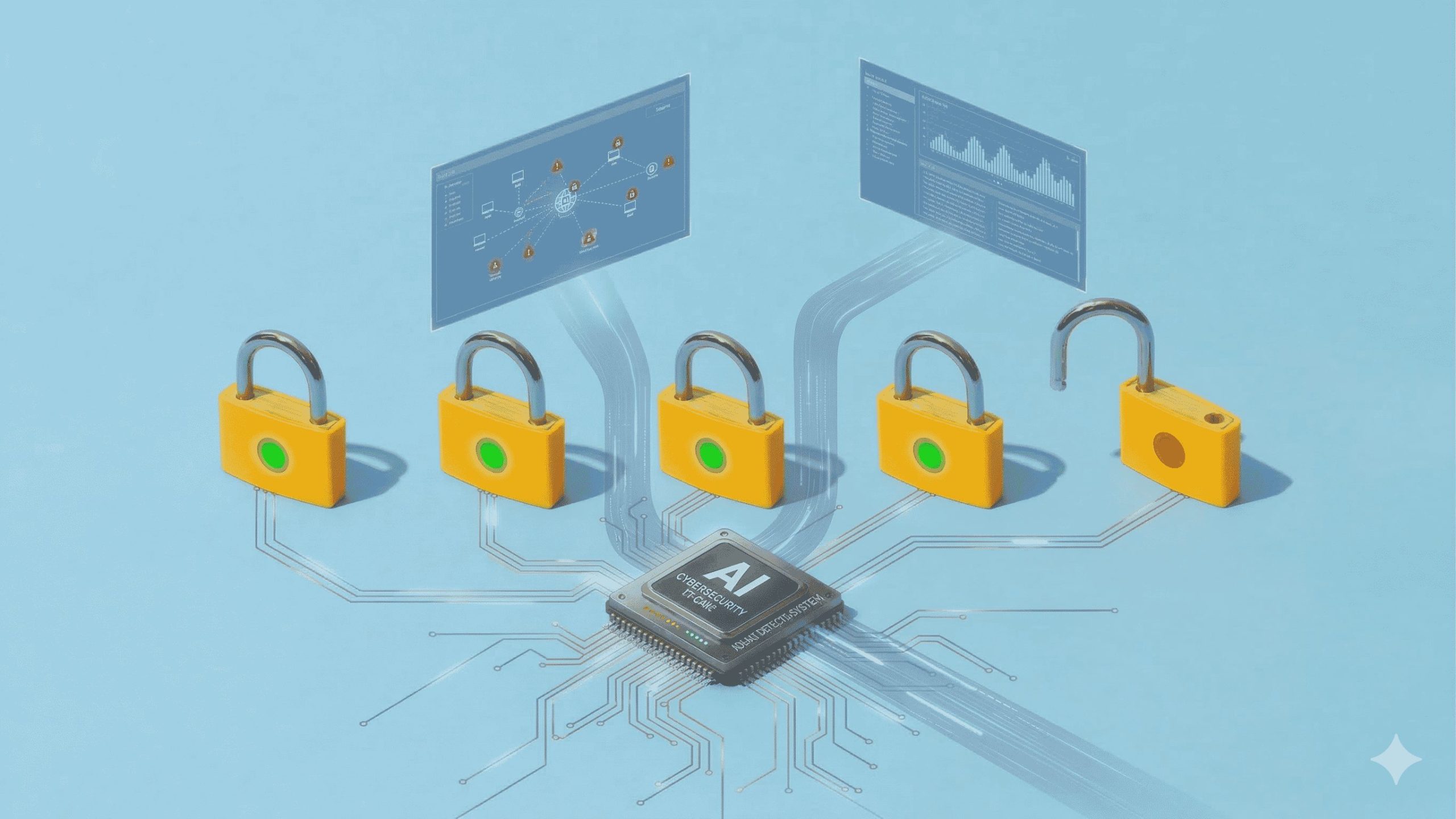
We designed a layered AI-security architecture that enhances the existing stack instead of replacing it. The solution focused on three outcomes: Better detection, Better prioritization, and Safe automation.
Solution Architecture (Layer-Based Breakdown)
1) Telemetry & Data Layer
The first layer of the system focused on collecting and centralizing security telemetry from multiple sources across the infrastructure. Signals were aggregated from SIEM event streams, endpoint telemetry including process, file, and network behavior, IAM and authentication events such as SSO usage, token activity, and privilege changes, as well as cloud control plane logs like API calls and security group modifications. Network flow logs were also included to identify unusual outbound traffic or potential lateral movement patterns within the environment. To ensure consistent analysis, a normalization pipeline standardized fields, timestamps, and entity identifiers while enriching the data with contextual information such as geo-IP data, device identity, and known malicious indicators.
2) Intelligence Layer (AI/ML Detection)
The intelligence layer used artificial intelligence and machine learning models to analyze the collected telemetry and identify potential threats. Two detection approaches were combined to improve accuracy and coverage. Unsupervised anomaly detection models were used to detect unknown or emerging threats by identifying abnormal behavior patterns such as unusual login times or locations, impossible travel scenarios, unexpected spikes in data access, unfamiliar process chains on endpoints, and rare outbound network connections that may indicate command-and-control activity. Alongside this, supervised classification models were trained to detect known attack patterns, including phishing-based credential abuse, privilege escalation sequences, malware-like process activity, and suspicious persistence mechanisms. The system evaluated these signals and generated risk scores with explainable factors highlighting the most influential indicators behind each alert.
3) Response & Orchestration Layer (SOAR-style)
Once potential threats were detected, the response and orchestration layer managed incident handling through predefined security playbooks. These playbooks were designed to trigger automated actions only when certain confidence and severity thresholds were met. The system could automatically enrich alerts by retrieving additional context such as user or device history and correlating related security events. When required, safe containment actions were executed, including isolating compromised endpoints, blocking suspicious IP addresses or domains, and disabling compromised authentication tokens. For higher-risk incidents, the system automatically escalated alerts by creating incident tickets with full contextual information and notifying on-call security personnel. Rollback mechanisms were also included so that access could be restored or actions reversed if an alert was later determined to be a false positive.
4) SOC Experience Layer
To support the security operations team, a centralized dashboard provided a clear operational view of detected threats and ongoing investigations. The interface presented a prioritized incident queue based on risk scores and confidence levels, allowing analysts to focus on the most critical threats first. Each incident included a detailed attack timeline showing the sequence of events that occurred, helping analysts understand how the threat developed. The dashboard also suggested recommended actions and allowed analysts to approve higher-risk automated responses with a single click when needed. In addition, the system maintained complete audit trails to support compliance requirements and provide transparency for all detection and response activities.
Key Technical Decisions
Why AI + Behavior Analytics (Not just more rules)?
Because modern attacks often look like legitimate behavior, especially identity-based threats. Behavior baselines + anomaly detection made it possible to spot “low and slow” compromise patterns.
Why “Guardrailed Automation” instead of full autonomy?
Security response has blast radius. We restricted automation to safe actions, and required approvals for high-impact steps, ensuring trust and adoption.
How we handled model risk:
We treated telemetry quality as a security dependency. We implemented validation checks, drift monitoring, and attack-simulation testing. We also assumed data inputs can be manipulated (poisoning / malicious artifacts), so we enforced dataset hygiene and anomaly checks in training and tuning cycles.
Results
Impact Summary
Within 90 days of pilot deployment, the AI security layer materially improved SOC efficiency and reduced operational risk by making detection faster and response more consistent.
Business Impact
The implementation of the AI-driven cybersecurity platform significantly improved the efficiency of the security operations team. Alert noise was reduced by approximately 55%, which allowed analysts to focus their attention on genuine threats rather than investigating large volumes of false positives. Faster threat containment also helped reduce the potential blast radius of security incidents and prevented repeated escalations of the same threats. In addition, operational overhead decreased as repetitive tasks such as alert enrichment and initial triage became automated through the system.
Technical Performance
From a technical perspective, the system delivered measurable improvements in detection and response speed. The mean time to detect potential threats improved from approximately 30 minutes to around 6 minutes after deployment. Similarly, the mean time to respond to incidents was reduced from roughly two hours to about 25 minutes due to automated response workflows and better alert prioritization. After model tuning and calibration, high-confidence detection precision stabilized at around 90 percent or higher. The platform also achieved near real-time threat scoring through continuous event ingestion and correlation across multiple telemetry sources.
What Changed
Before: analysts were investigating alerts one-by-one, often without context, and response depended heavily on experience and manual speed.
After: the SOC received ranked incidents with timelines, evidence signals, and policy-safe automation that handled containment and escalation consistently.
Stakeholder feedback (client voice)
“We didn’t need more alerts. We needed better signal and faster response. The AI layer helped our SOC move from reactive triage to proactive containment.” — Security Operations Lead (Client)