
Client Context
DocCore is a mid-size enterprise company, operating in the legal and compliance domain. The organization manages tens of thousands of documents including contracts, policies, invoices, compliance reports, and internal SOPs stored across SharePoint, cloud drives, and internal databases.
While documents were digitally stored, they were largely passive assets, searchable only through keyword matching and manual review. Knowledge workers such as legal analysts, compliance officers, and support teams spent significant time reading, cross-referencing, and copying information between documents and systems.
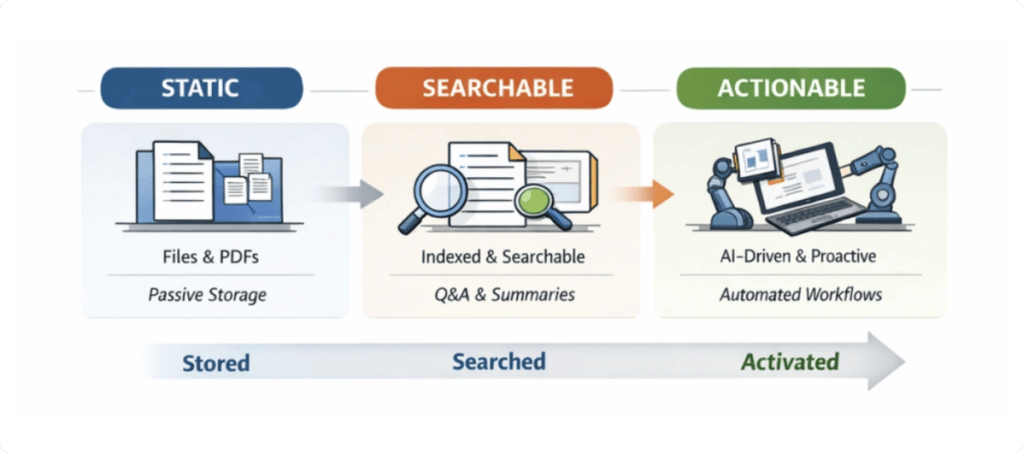
The leadership team wanted to transform documents from static storage into an active intelligence layer that could answer complex questions and assist with real business workflows.
The Challenge
Despite having digitized documents, DocCore faced multiple operational bottlenecks:
Inaccessible Intelligence
Over 80% of organizational knowledge existed in unstructured formats (PDFs, DOCs, scanned files). Traditional search systems failed to understand intent, context, or relationships across documents.
Manual “Stare-and-Compare” Work
Employees manually extracted clauses, dates, and values from documents and entered them into downstream systems such as CRMs, ERPs, and ticketing tools, which sometimes introduces delays and human errors.
Isolated Context
Different teams accessed different document repositories. For example, legal teams could see contracts, but not customer activity or billing context, leading to fragmented decision-making.
Static Question Handling
Complex questions like “Which contracts expiring next quarter violate our updated compliance policy?” required manual, multi-day analysis across multiple document sets.
Collaborative Approach
We worked closely with DocCore’s legal, compliance, IT, and data teams through a series of discovery workshops and technical design sessions.
The engagement focused on:
- Understanding real user workflows rather than generic “chat with documents”
- Identifying where action was required beyond simple answers
- Evaluating traditional RAG systems versus emerging Agentic RAG patterns
- Defining safe automation boundaries with human oversight
This collaborative approach ensured the solution aligned with business risk tolerance and regulatory requirements.
Solution
We designed and implemented an Agentic Retrieval-Augmented Generation (Agentic RAG) system to transform documents into searchable and actionable intelligence.
Why Not Standard RAG?
Standard RAG systems work well for:
- Summarizing documents
- Answering factual, single-document questions
However, they are reactive and linear (Retrieve → Generate).
They cannot:
- Break down multi-step tasks
- Compare information across documents
- Use external tools or systems
- Take follow-up actions
Why Agentic RAG?
Agentic RAG introduces an AI agent layer that can:
- Plan multi-step reasoning
- Retrieve from multiple sources
- Use tools (calculations, APIs, workflows)
- Self-correct when results are insufficient
- Produce outputs that drive action
This shifted documents from passive knowledge to an active digital workforce.
Core Components
Document Ingestion & Indexing
- PDFs, Word files, scanned documents processed using OCR
- Semantic chunking and metadata enrichment
- Vector embeddings stored in a vector database
Agent Planner (Brain Layer)
- Interprets user intent
- Decides whether the task is informational or actionable
- Breaks complex requests into sub-tasks
Retrieval Layer
- Semantic search across multiple repositories
- Context-aware filtering (date, document type, department)
Tool Integration
- CRM and contract databases
- Calendar and notification services
- Email and ticketing APIs
Reflection & Self-Correction
- Agent evaluates intermediate results
- Re-queries or refines searches if information is incomplete
- Escalates to human review when confidence is low
Technical Implementation
Architecture Flow
- User submits a natural-language request
- Agent planner analyzes intent and constraints
- Relevant documents are retrieved via vector search
- Agent executes reasoning steps and tool calls
- Results are validated and synthesized
- Final response includes information + recommended or executed actions
Security & Governance
- Role-based access control on documents and tools
- Read-only mode for high-risk workflows
- Full audit trail of agent decisions and actions
- Human-in-the-loop approval for sensitive operations
Scalability
- Stateless agent execution
- Horizontal scaling for document retrieval
- Modular tool registry for future workflows
Use-Case Scenarios
Scenario 1: Active Legal Contract Review
Before:
Legal teams manually reviewed dozens of contracts to identify risk clauses and renewal dates.
With Agentic RAG:
- Searchable: Instantly identifies all contracts containing specific clauses
- Actionable: Extracts expiry dates, checks active clients, drafts renewal emails
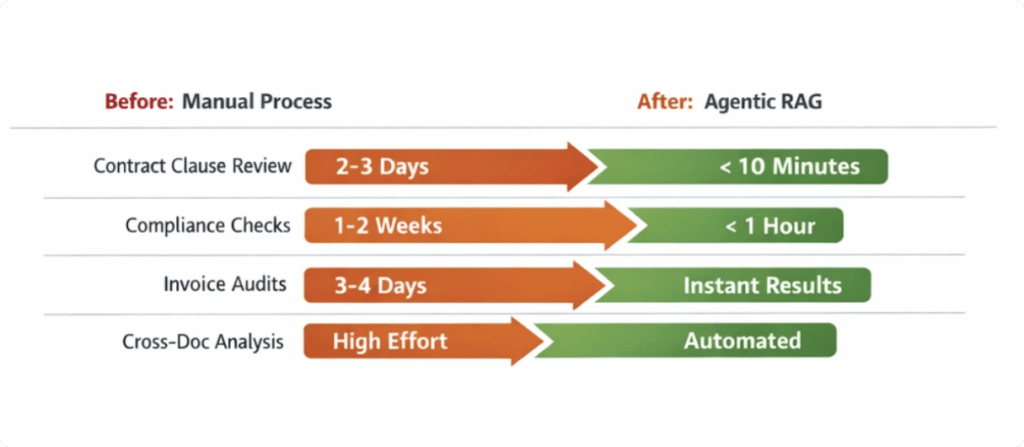
- Impact: Review time reduced from weeks to minutes; zero missed deadlines
Scenario 2: Autonomous Compliance Auditing
Before:
Auditors sampled only a small percentage of invoices due to time constraints.
With Agentic RAG:
- Searchable: Ingests 100% of invoices and policy documents
- Actionable: Automatically checks each invoice against policy rules
- Impact: Full audit coverage, immediate violation detection, faster enforcement
Measurable Outcomes
Document search time → Reduced by ~70%
Manual review effort → Reduced by ~60%
Compliance coverage → Increased from ~5% sampling to 100%
Decision turnaround → Reduced from days to minutes
User satisfaction → Significant improvement across legal and compliance teams
Workflow Transformation

Time-to-Decision Improvement
Document Evaluation
Key Learnings
While standard RAG enhances information retrieval, Agentic RAG fundamentally transforms how work is executed by connecting insights directly to actions. Documents create the greatest value when they are not just referenced but embedded into workflows that drive decisions and operations. For enterprise use, strong guardrails and auditability are essential to ensure reliability, compliance, and trust. A human-in-the-loop approach further strengthens confidence in AI systems while accelerating adoption across teams. Overall, agentic systems mark a shift in AI’s role — moving beyond simply providing answers to actively delivering measurable outcomes.
Future Outlook
Future plans focus on expanding agent capabilities to handle more complex tasks. Multi-agent collaboration will support large-scale audits, while cross-department knowledge fusion will enable smarter, more connected decision-making across the organization.
Deeper system integration is another priority. Automation within ERP and finance systems will streamline operations, reduce manual effort, and improve accuracy. Policy-driven approvals and escalations will ensure processes stay compliant and efficient.
Proactive intelligence will make agents more forward-looking. Continuous monitoring of document changes and automated alerts for risks, renewals, or compliance gaps will help teams act early and move from reactive to preventive management.Future plans focus on expanding agent capabilities to handle more complex tasks. Multi-agent collaboration will support large-scale audits, while cross-department knowledge fusion will enable smarter, more connected decision-making across the organization.
Stakeholder Feedback
“This is the first time our documents feel like they are actually working with us.
The system doesn’t just answer questions but it helps us finish work.”
— Head of Compliance, DocCore