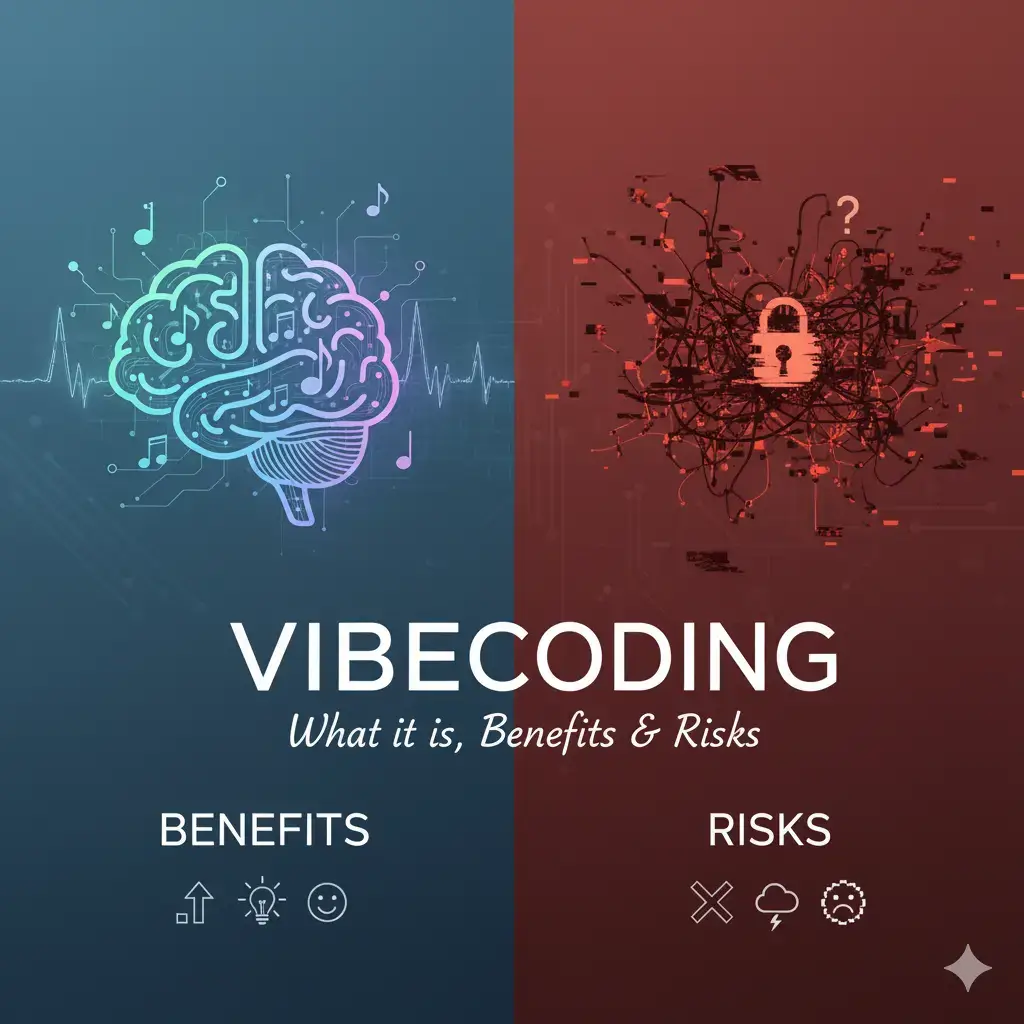
You ask an AI to build your app. It writes the code. You press “Accept All.” You deploy. And it’s done. Welcome to vibe coding. It’s fast, chaotic, creative, and kind of terrifying if you’re thinking about scaling that demo to a real product.But let’s take a step back: Is vibe coding just a fun hackathon trick? Or is it actually a viable strategy for modern software teams? Let’s talk about where it shines, where it absolutely does not, and how you can actually use it.
What Vibe Coding Is (and Isn’t)
Vibe coding: You describe an application or change in natural language, the AI generates code, and you accept it wholesale by prioritizing speed and iteration over inspection. The goal is to “forget that the code even exists.”
AI‑assisted development: You still use AI, but you review, test, and explain every line before merging. That’s not vibe coding.
Major vendors now market end‑to‑end app generation tools (e.g., Gemini Code Assist, AI Studio, Firebase Studio), which may be useful accelerators for structure and prompts. But adopting these tools does not automatically mean you’re vibe coding; the dividing line is whether humans exactly review the output or not. Platforms like Replit are pushing one‑prompt “full‑stack” creation as well. Again, these are powerful for ideation, but still separate from the “don’t read the code” attitude that defines vibe coding.
Where Vibe Coding Shines
- Hackathons & weekend projects: When speed matters more than structure.
- Prototyping or POCs: To test ideas quickly before investing heavily in architecture.
- Learning environments: Ideal for exploring AI capabilities without overthinking engineering best practices.
The Reality Check: Risks That Bite in Production
Security Concerns
A Veracode report found that 45% of AI-generated code contains known security vulnerabilities, ranging from hardcoded credentials to missing validations.In one real-world case, a developer unknowingly exposed OpenAI API keys via AI-generated code, leading to a $14,000 surprise bill (Software Mind., 2025).
Technical Debt & Maintainability
Startups that vibe-coded their MVPs often had to rewrite their apps from scratch once real users and investors came into play. Because there was no documentation, no reasoning behind logic, and certainly no tests. It looked like code but no feel of the production grade system at all.
Tool Limitations
Even top-tier AI editors like Cursor struggle to handle large, unstructured vibe-coded projects. They lack context awareness across multiple files, making refactoring and scaling a mess (Software Mind., 2025).
When NOT to Vibe Code
Vibe coding should come with a disclaimer: Not safe for production use.
Avoid it in:
✔️ Financial or healthcare systems
✔️ Apps that manage user data or payments
✔️ Anything requiring long-term maintainability or scalability
Why? Because these environments demand accountability, compliance, and security audits. And none of which fit in the vibe coding workflow.
So… Is Vibe Coding Worth It?
- Yes, if:
- You want to prototype an idea quickly.
- You’re building for fun, internal testing, or rapid iteration.
- You treat it like a disposable draft—not a foundation.
- No, if:
- You’re heading to production.
- You’re working on multi-team codebases.
- You need testability, security, and traceability.
In other words, vibe coding is great for discovery—not delivery.
A Balanced Approach: Vibe First, Engineer Later
If you’re excited by vibe coding, that’s fair because it unlocks a new creative workflow. But once you’ve validated the idea:
- Refactor and rewrite: Don’t ship unreviewed code.
- Add tests and CI/CD: Stabilize what the AI created.
- Introduce peer reviews: Make sure others can reason about the codebase.
- Secure your environment: Check for secrets, auth flows, and error handling.
- Think of vibe coding as whiteboarding with AI—just don’t treat it as your blueprint for production.