Client Context
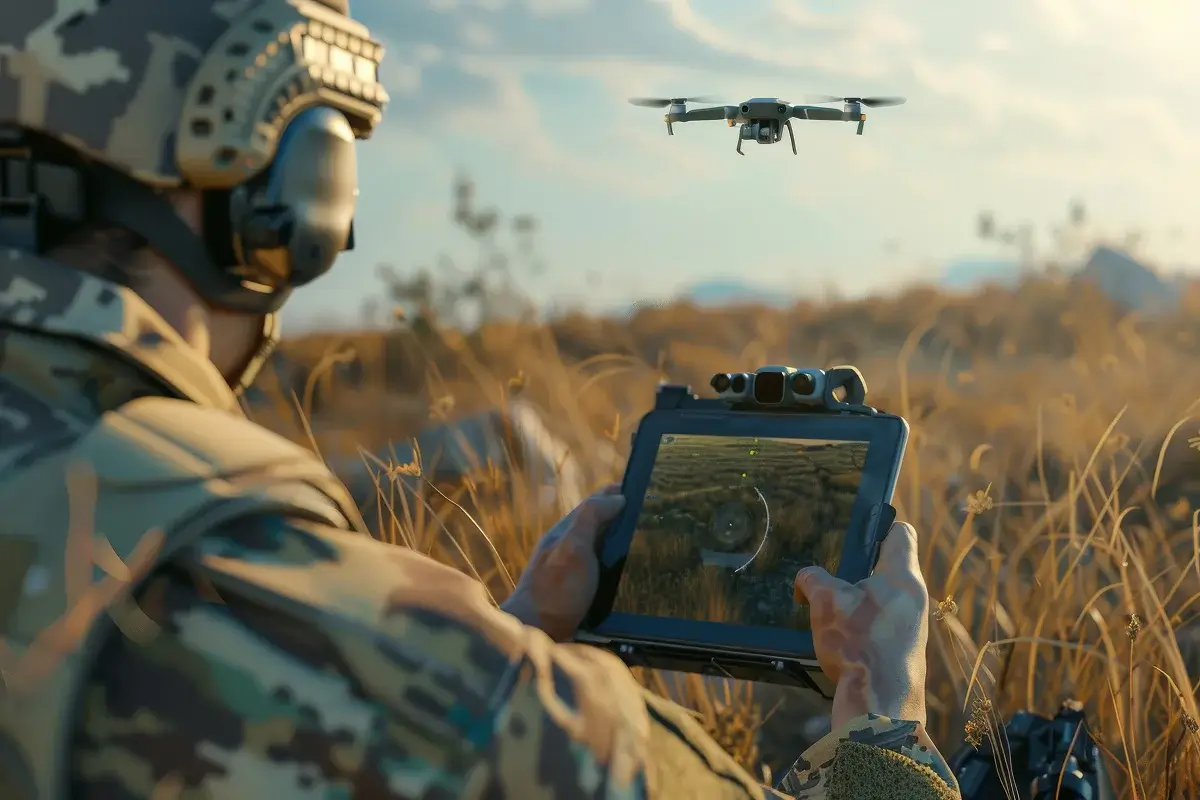
The client is a national-level security department responsible for border surveillance, crowd monitoring, and high-risk event protection. With increasing demand for real-time intelligence and rapid situational assessment, they sought a modern solution that blends aerial agility with advanced analytics. Traditional systems were effective, but manual monitoring, delayed threat detection, and coverage limitations prompted the need for an AI-integrated drone system.
The Challenge
- Manual Monitoring Delays: Security personnel monitoring drone footage in real-time missed critical anomalies due to fatigue and human error
- Limited Coverage: Ground units and static cameras could not efficiently monitor vast, high-risk zones such as border lines or large public gatherings
- Slow Response Time: Without autonomous alerts, responses to suspicious activity were reactive rather than preventive
- Compliance & Data Security: Ensuring the solution adheres to airspace laws, data protection standards, and ethical surveillance practices
Collaborative Approach
We engaged in a multi-stakeholder consultation that involved field operatives, compliance officers, and tech teams to define operational needs. The workshops helped co-design AI models that aligned with ground realities, prioritize low-latency communication, and define ethics-informed alert thresholds. A rapid prototyping approach combined with real-world simulations was adopted to refine the system.
Solution Overview
We implemented an AI-integrated drone surveillance system with the following capabilities:
- Real-time video streaming using encrypted feeds.
- AI-based threat detection powered by trained machine learning models.
- Dynamic object tracking and motion pattern analysis.
- Role-based access to live feeds and historical data.
- Automated alerting system integrated with control room dashboards.
Core Components
| Component | Description |
| Hardware (Drone Kit) | Commercial drones upgraded with thermal imaging, night vision, and onboard GPU modules for edge computing. |
| AI Engine | Onboard object detection and anomaly detection models trained on custom datasets. |
| Control System | Web-based secure interface for real-time feed access, alerts, and manual override. |
| Communication Layer | Low-latency 5G/4G fallback connectivity with end-to-end encryption. |
| Storage | Federated storage architecture using hybrid cloud for real-time caching and offline analysis. |
Technical Implementation
Edge AI Deployment: Drones perform primary analytics on-device using lightweight ML models to detect anomalies like unauthorized gatherings, perimeter breaches, or suspicious motion.
Command Centre Integration: AWS IoT Core and Lambda functions were used for secure two-way communication.
Threat Categorization: Detected threats are prioritized and color-coded for faster decision-making.
Logging & Tracing: AWS CloudWatch and X-Ray trace every drone’s telemetry, event logs, and AI inferences for later auditing.
Security Compliance: Data is encrypted using AES-256, and access is governed via IAM roles and multi-factor authentication.
Measurable Outcomes
| Metric | Outcome |
| Latency | Live video latency reduced to <2.5 seconds. |
| Detection Accuracy | AI models achieved 92% precision in object/person detection. |
| Operational Coverage | Drones covered 60% more area than static cameras in the same timeframe |
| Response Time | Average response time improved by 35% in high-alert scenarios. |
| Cost Efficiency | Reduced manpower deployment by 25% in monitored zones. |
Key Learnings
- Edge Computing is Critical: Real-time decisions are only possible when inference happens on the drone, not just in the cloud.
- AI Training Requires Local Context: Generic object models were insufficient; training with local threat scenarios improved detection drastically.
- Security-Ethics Balance: Transparency protocols and access restrictions are essential to maintain trust and prevent misuse.
- Hybrid Project Management Works Best: Prince2 ensured compliance; Agile helped iterate AI models rapidly with feedback loops.
Future Outlook
- Multi-Drone Swarm AI: Coordinated drone behaviour with shared intelligence.
- Satellite & Drone Data Fusion: Integrate aerial drone feeds with satellite imaging for macro-micro security mapping.
- Ethical Surveillance Protocols: Implementing AI Explainability and Human-in-the-Loop systems
- International Trials: Expand deployment to border control units in partner countries.