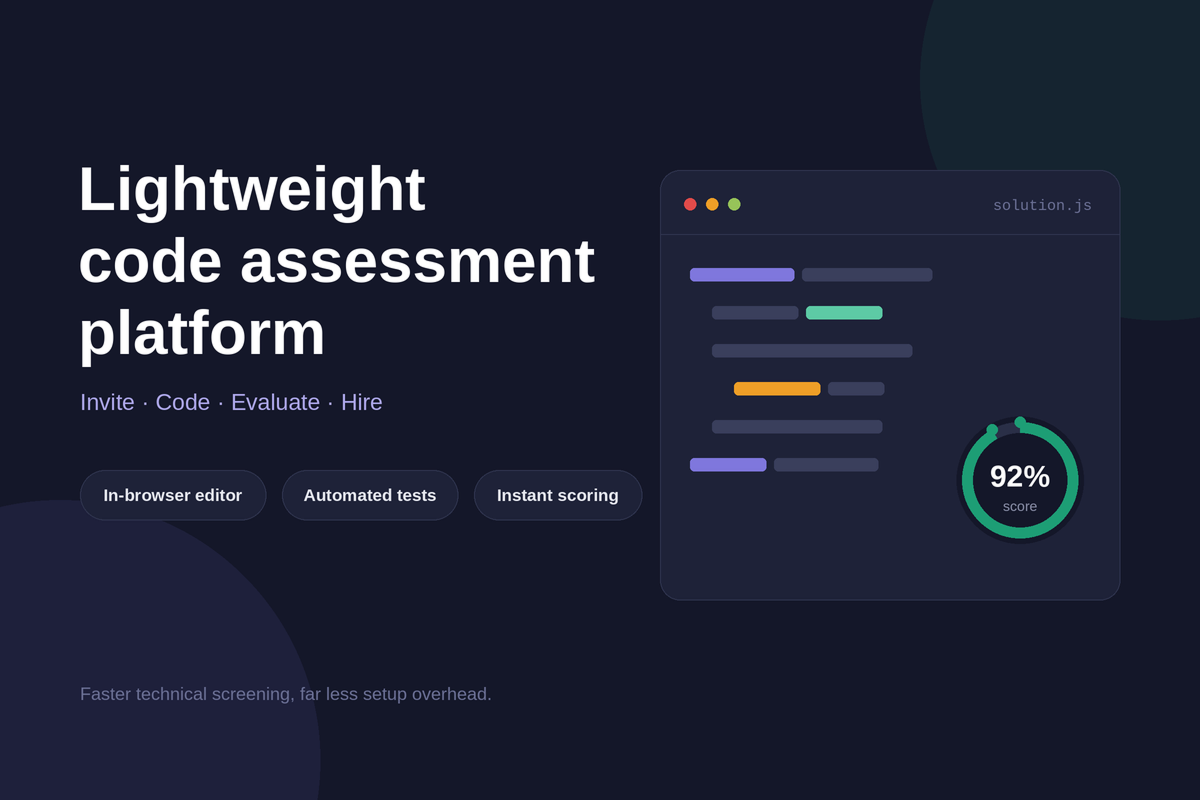
Helping Companies Evaluate Developers Faster and Fairly
Overview
Hiring skilled developers is not easy when a company receives hundreds of applications for a limited number of technical roles. Manual resume screening can identify experience, but it does not always show practical coding ability. Traditional interview rounds also take too much engineering time, especially when every candidate needs to be reviewed manually.
To solve this problem, we developed a Lightweight Code Assessment Platform that allows companies to create coding tests, invite candidates, run code safely, auto-evaluate submissions, and generate structured reports. The goal was not to build a heavy enterprise recruitment system, but a simple, fast, and focused platform for technical screening.
The platform was designed for startups, IT service companies, and internal hiring teams that need a quick way to assess coding skills without depending fully on third-party tools. Modern coding assessment platforms commonly include automated scoring, analytics, proctoring, and plagiarism checks, which shows that automation and fairness have become important parts of technical hiring.
Client Context
The client was a mid-sized IT services company that frequently hired junior and mid-level developers for projects in web development, backend APIs, and cloud-based systems. Their hiring team received a large number of applications, but their technical team had limited time to manually review every candidate.
Before this solution, the company used basic Google Forms, shared coding questions through documents, and reviewed code manually through email or GitHub links. This process worked for small hiring batches, but it became inefficient when the number of candidates increased.
They needed a platform that was simple to use, fast to deploy, and secure enough to run candidate code in a controlled environment. At the same time, it had to be easy for both HR teams and technical reviewers to manage assessments, review candidate results, and shortlist developers. The company also wanted the solution to be affordable compared to large enterprise hiring tools, while still covering the core code assessment workflow.
Quick Stats
- Manual Review Time: Reduced by 60%
- Candidate Screening Speed: Improved by 3x
- Code Execution Time: Average result under 5 seconds
- Assessment Setup Time: Reduced from 1 hour to 10 minutes
- Reviewer Workload: Reduced through automated scoring
Challenges
The client’s main challenge was not only about hiring developers faster. The real problem was building a fair, repeatable, and scalable technical evaluation process.
Their existing assessment process had multiple problems.
First, candidate evaluation was highly manual. Developers had to open each submission, run the code locally, check output, compare logic, and then write feedback. This consumed hours of engineering time that could have been spent on actual product development.
Second, assessments were inconsistent. Different reviewers judged solutions differently. One reviewer focused on output correctness, another focused on code quality, and another focused on performance. This created confusion during final candidate shortlisting.
Third, the existing process did not support safe code execution. Running unknown candidate code directly on a local machine or shared server is risky. A code assessment platform needs sandboxing, resource limits, and isolation because it runs untrusted code. Modern sandbox systems often use containers, Kubernetes, microVMs, or similar isolation layers to control execution and reduce risk.
Fourth, there was no central dashboard. HR could not easily track which candidates completed the test, which submissions passed, and which candidates needed review. The technical team also had no single place to compare candidate performance.
Fifth, cheating and copied answers were hard to detect. The company did not need very heavy AI proctoring at the first stage, but they wanted basic protection such as copy-paste monitoring, test timing, code similarity checks, and submission logs. Anti-cheating and plagiarism checks are now common expectations in coding assessment tools.
Core Challenges
The technical team was spending too much time reviewing basic coding submissions manually, which created a major bottleneck in the hiring process. Candidate evaluation was also inconsistent because scores depended more on individual reviewer opinions instead of structured test cases and automated scoring rules. There was also a security risk, as candidate code needed to run in an isolated environment rather than directly on internal machines. Along with this, HR and technical reviewers had no centralized view of test progress, completed submissions, and final results. The old process was manageable for a small batch of 10 candidates, but it was not scalable enough to handle 100 or 500 candidates efficiently.
Why This Mattered
Technical hiring is directly connected to project delivery quality. If the company hires the wrong developer, it affects code quality, delivery speed, and client satisfaction. But if hiring takes too long, good candidates may accept offers elsewhere.
So, the company needed a system that could reduce manual effort while still keeping technical evaluation meaningful.
Strategy
We designed a lightweight, modular code assessment platform focused on three main goals: Speed, Security, Evaluation consistency. Instead of building a complex recruitment suite with every possible feature, we created a focused platform that solves the core hiring workflow.
The platform allows an admin or technical reviewer to create coding assessments, add questions, define test cases, invite candidates, execute submitted code in a secure sandbox, auto-score the result, and generate a candidate report.
Solution Architecture (Layer-Based Breakdown)
1. Candidate Assessment Interface
The candidate assessment interface was designed to be clean, simple, and distraction-free. Candidates could open the assessment link, read the instructions, understand the coding problem, run sample test cases, and submit their final answers from one place. The interface included a code editor, question description, input and output format, sample test cases, timer, run button, submit button, and language selector. For the first version, the platform supported common programming languages such as JavaScript, Python, Java, and C++, as these languages covered most of the client’s hiring requirements. The main UX goal was simplicity, so candidates did not have to waste time learning how to use the platform and could focus completely on solving the coding problem.
2. Assessment Management Dashboard
The assessment management dashboard allowed HR teams and technical reviewers to create, configure, and manage coding assessments from a centralized place. Through this dashboard, users could create assessments, add coding questions, set test duration, choose allowed programming languages, define visible and hidden test cases, invite candidates by email, track assessment status, and view score reports. This helped HR manage the technical screening process without depending on developers for every small update. For example, once a technical lead created a reusable “Junior Backend Developer Test,” HR could use the same assessment for multiple hiring rounds, which saved time and made the process more consistent.
3. Code Execution Engine
The code execution engine was the most important technical component of the platform because it handled the actual running of candidate submissions. Since candidate code is untrusted by default, it was not safe to run it directly inside the main application server. To solve this, we used a sandbox-based execution model where each submission runs in an isolated environment with strict time, memory, and CPU limits. When a candidate submits code, the submission is stored in the database, an execution job is pushed into a queue, and a worker service picks up the job. The code is then executed inside an isolated container, the output is captured and compared with the expected result, the score is calculated, and the result is stored and shown in the dashboard. This queue-based design helped the platform handle multiple submissions smoothly without blocking the main application.
For the initial version, Docker-based containers were used for isolation. This made the execution process practical, controlled, and easier to manage. We also added important security restrictions such as no external network access during code execution, maximum execution time per test case, memory usage limits, CPU usage limits, temporary file cleanup after execution, separate execution environments per submission, and output size limits. These controls helped prevent infinite loops, memory abuse, unsafe execution behavior, and unnecessary pressure on platform resources.
4. Scoring and Evaluation Service
The scoring and evaluation service compared the candidate’s output with the expected output and calculated the final score. The platform supported two types of test cases: visible test cases and hidden test cases. Visible test cases were shown to candidates for basic validation, while hidden test cases were used for final scoring. This prevented candidates from only hardcoding sample outputs and helped evaluate whether the solution worked for different scenarios. The scoring system checked correctness, number of passed test cases, runtime limit, memory limit, compilation errors, runtime errors, and partial score. For example, if a question had 10 hidden test cases and the candidate passed 7, the system could assign 70% correctness for that question. This automated evaluation reduced manual review effort and allowed engineers to focus only on deeper code quality review where needed.
5. Reporting and Analytics Layer
After a candidate submitted the assessment, the platform generated a structured report that helped the hiring team understand the candidate’s performance clearly. The report included candidate name and email, assessment name, completion status, total score, question-wise score, passed and failed test cases, execution errors, time taken, submitted code, and reviewer comments. This made it easier for HR and technical reviewers to compare candidates objectively instead of depending only on manual judgment. A technical reviewer could still open the submitted code and add manual comments, but the first-level screening became automated, faster, and more consistent.
6. Security and Monitoring Layer
Security was considered from the beginning because the platform handled candidate information and executed unknown code. The platform included role-based access control, JWT-based authentication, hashed passwords, HTTPS deployment, submission logs, admin activity logs, sandbox execution, rate limiting, input validation, and error logging. These measures helped protect candidate data, platform access, and execution workflows. Along with security, monitoring was added to track failed executions, worker queue length, average execution time, API errors, assessment completion rate, and server resource usage. This helped the team understand platform health, detect issues early, and improve reliability over time.
Technical Implementation
Frontend
The frontend was built as a responsive web application so candidates and admins could use it easily from different devices. The candidate side was kept minimal and focused only on the assessment flow, while the admin side included dashboards and tables for managing assessments. The main frontend features included an assessment landing page, code editor, timer component, question navigation, submission confirmation page, admin dashboard, and candidate result view. A browser-based code editor was also integrated to give candidates a familiar coding experience during the test.
Backend
The backend handled the main business logic of the platform, including authentication, assessment management, question storage, candidate invitations, code submissions, scoring, and report generation. It was divided into modules such as auth, user and role management, assessment, question, submission, execution queue, result, and report modules. The backend exposed REST APIs that connected with the frontend and allowed both candidate and admin workflows to function smoothly.
Database
The database stored all important platform data, including users, candidates, assessments, questions, test cases, submissions, execution results, reports, and audit logs. Questions and test cases were stored separately so that the same question could be reused across multiple assessments. This made the system more maintainable and helped the client build a reusable question library for future hiring rounds.
Queue and Worker System
A queue was used between the backend and the code execution worker to keep the main application stable. This was important because code execution can take time, especially when many candidates submit their answers at the same time. Without a queue, the main API server could become slow or overloaded. The worker service picked pending submissions, prepared the code file, ran the code inside the sandbox, captured the output, compared it with the expected result, and updated the final result status. This design made the platform more reliable, scalable, and suitable for handling multiple submissions in parallel.
Sandbox Execution
Each code submission was executed inside a temporary isolated container to keep the main platform safe. The container received the candidate code, selected language runtime, input test cases, and execution limits. After execution, the system collected the standard output, standard error, exit code, execution time, and memory usage. Once the result was captured and stored, the temporary environment was cleaned automatically. This helped prevent unsafe code behavior, resource misuse, and unnecessary storage buildup.
Admin Workflow
The admin workflow was designed to be simple and reusable. An admin or technical reviewer could create an assessment, add the title, description, and duration, add coding questions, define visible and hidden test cases, invite candidates, monitor completion, and review final reports. This made assessment creation faster and allowed HR teams to reuse existing assessments for multiple hiring rounds without depending on developers every time.
Key Technical Decisions
Why Lightweight Instead of Full Enterprise Platform?
The client did not need a large hiring suite with resume parsing, video interviews, AI interviewers, and enterprise HRMS integration. They needed a focused platform for coding evaluation. So, we avoided unnecessary complexity and built only the essential features first.
Why Queue-Based Execution?
Code execution is unpredictable. Some code may run fast, some may fail, and some may get stuck in infinite loops. By using a queue, the platform separates normal application traffic from code execution workload. This improves stability and allows worker scaling later.
Why Docker-Based Sandbox?
Docker provided a practical starting point for isolated execution. It was easier to implement, test, and deploy compared to more advanced microVM-based approaches. For future higher-security workloads, the platform can move toward stronger isolation models such as gVisor, Firecracker, or Kubernetes-native sandboxes.
Why Hidden Test Cases?
Visible sample tests are useful for candidates, but they are not enough for real evaluation. Hidden test cases ensure that the candidate writes a general solution instead of hardcoding answers.
Results
After the platform was introduced, the client’s hiring workflow became faster and more structured.
Business Impact
The platform created a strong business impact by reducing manual review time by 60%. Developers no longer needed to check every basic coding submission manually, as the system automatically scored most candidate answers and allowed them to focus only on shortlisted or borderline candidates. The screening process also became 3x faster because HR could send assessment links in batches and receive automated scores without waiting for the technical team to review each submission. Candidate comparison became more fair and consistent because every candidate was evaluated using the same test cases and scoring rules. The reusable assessment library also helped the client use the same coding tests across multiple hiring rounds, which saved setup time. Overall, the company reduced its dependency on expensive external hiring tools for first-level coding screening, which helped lower hiring costs while keeping the process structured and reliable.
Technical Performance
The platform delivered strong technical performance by executing most simple and medium coding problems in under 5 seconds within the defined time and memory limits. Candidate code was executed safely inside an isolated environment instead of the main application server, which reduced the risk of unsafe code affecting the platform. The system also used a scalable worker model, where execution workers could be scaled separately from the main backend based on submission volume. This helped the platform handle multiple candidate submissions more efficiently. Along with this, visibility improved because admins could track assessment status, completion rate, execution results, and candidate scores from a single dashboard.
What Changed
Before the platform, the hiring process was scattered across different tools such as forms, emails, spreadsheets, and manual code reviews. This made the process slow, inconsistent, and difficult to manage when the number of candidates increased. After the platform was implemented, HR teams could create and manage assessments independently, candidates received a smooth online coding test experience, and developers only had to review fewer but better-filtered submissions. Scores were generated automatically, candidate reports were stored centrally, and the company gained a repeatable technical screening process. Overall, the hiring workflow changed from manual and inconsistent to automated, structured, and easier to scale.
Stakeholder Feedback
Future Outlook
In the future, the platform can include AI-based code review suggestions to identify code quality issues, inefficient logic, readability problems, and possible improvements in candidate submissions. However, human approval should still remain important for final hiring decisions because AI can support evaluation, but it should not fully replace technical judgment.
The platform can also include plagiarism detection by adding a similarity-checking engine that compares candidate submissions with each other and identifies copied or highly similar answers. For high-stakes assessments, optional proctoring features can be added, such as browser monitoring, tab-switch detection, webcam proctoring, and copy-paste restrictions.
For senior developer hiring, the platform can support Git-based project assessments where candidates work with a real repository instead of solving only algorithmic questions. This would help evaluate practical engineering skills such as project structure, debugging, commits, documentation, and code maintainability.
The system can also integrate with LMS and HRMS tools so companies can connect assessments with employee training, recruitment workflows, or internal learning programs. In the long term, the platform can be converted into a multi-tenant SaaS product where multiple companies can create their own assessment workspaces, manage users, run coding tests, and review candidate performance independently.
Key Learnings
- A code assessment platform should not only focus on running code. It should focus on fair evaluation, safety, usability, and reviewer efficiency.
- Sandboxing is critical because candidate code is untrusted by default.
- Hidden test cases are important to evaluate real problem-solving ability.
- A queue-based worker model makes code execution more reliable and scalable.
- A lightweight platform can be more useful than a heavy enterprise system when the client’s requirement is focused.
- The best technical hiring workflow combines automation with human judgment.
FAQ
1. What is a Lightweight Code Assessment Platform?
A Lightweight Code Assessment Platform is a focused system that helps companies create coding tests, invite candidates, run code safely, auto-score submissions, and generate reports. It is called lightweight because it avoids unnecessary enterprise complexity and focuses mainly on technical screening.
2. How does the platform run candidate code safely?
Candidate code runs inside an isolated sandbox environment. Each submission gets limited CPU, memory, execution time, and file access. This prevents candidate code from affecting the main application server.
3. Why is sandboxing important?
Sandboxing is important because candidate code is untrusted. A candidate may accidentally or intentionally write code that consumes too much memory, runs forever, accesses files, or tries to connect to external systems. Sandboxing reduces this risk.
4. How does automated scoring work?
Each coding question has predefined test cases. When the candidate submits code, the system runs the code against those test cases and compares the actual output with the expected output. The score is calculated based on passed test cases, errors, and execution limits.
5. Can reviewers still manually check code?
Yes. The platform does not fully remove human review. It reduces first-level manual work. Reviewers can still open submitted code, check logic, add comments, and make final decisions.
6. How does this improve fairness in hiring?
All candidates are evaluated using the same questions, same time limit, same test cases, and same scoring rules. This reduces personal bias and makes comparison easier.
7. Can the platform detect cheating?
The first version includes basic protections such as time limits, logs, hidden test cases, and submission tracking. Future versions can include plagiarism detection, browser monitoring, and proctoring.
8. What technologies can be used to build this platform?
A typical stack can include React or Vue for frontend, Node.js or Go for backend, PostgreSQL or MongoDB for database, Redis or RabbitMQ for queues, Docker for sandbox execution, and cloud hosting on AWS, Azure, or GCP.
9. Is this platform only useful for hiring?
No. It can also be used for employee training, university coding assignments, internship screening, coding bootcamps, and internal developer skill evaluation.
10. What is the biggest advantage of this solution?
The biggest advantage is that it reduces manual review effort while keeping the evaluation structured and practical. It helps companies screen more candidates in less time without losing technical quality.