
Client Context
GoTours is a multinational travel booking platform. It allows users to discover, book and confirm tour packages and hotels. On a usual day of year, their business faces moderate traffic. But it rises by 5x-10X during major holidays, promotions or in travel season.
The Challenge
GoTours was facing these struggles during seasonal spikes because of their legacy monolithic infrastructure:
- Scaling Constraints: The fixed stack of servers often becomes overloaded during peak time of requests, which leads the system to crash or in a slow response time.
- High Infrastructure Cost: Maintaining this stack of servers (“worst-case” capacity) for the whole year means paying even for the idle servers when not needed.
- Reliability Issues: Any type of peak traffic needs manual intervention, that can not be done every time, and it results in system downtime. It directly causes damage to the customer’s trust regarding system availability.
- Slow Development: Because of a monolithic system, it is difficult to quickly add new features or fix any issue, without risking the stability of the entire application
Collaborative Approach
We worked closely with GoTours’s management and IT teams via a series of workshops and technical meetings to clarify core requirements. We explored solutions like autoscaling servers, container orchestration and serverless architecture. This inclusive approach ensures minimal adoption risk.
Solution Overview
The recommended solution was a fully serverless ecosystem on AWS, which includes AWS Lambda for compute, Amazon API Gateway for routing, and other managed services for data storage and authentication. It provides,
- Completely automatic instant scaling to handle high traffic surges.
- It has a pay-as-you-use cost-model which reduces expanses when demand is low.
- It simplifies operational work by completely offloading server management to AWS.
Core Components
API Layer
We used Amazon API Gateway to handle RESTful endpoints (like /tours, /bookings, etc) and integrated it with AWS Lambda.
Compute
There are AWS Lambda functions for each workflow or functionality, which will scale automatically based on requests.
Database
We used Amazon DynemoDB to store tour and booking related data on serverless capacity mode.
Storage
We used Amazon S3 to store images and website assets.
User Authentication
There is Amazon Cognito for user sign-up, sign-in, and token-based authorization.
Notifications
We used Amazon SNS to send booking confirmation emails and alerts.
Monitoring
Amazon CloudWatch is used for logs, metrics and alerts. AWS X-ray is used for tracing and insights.
Technical Implementation
Infrastructure as Code: We used AWS templates (AWS SAM) to define all resources like API routes, Lambda functions, DynamoDB tables in a consistent manner.
Refined Data Model: DynamoDB was structured in a way for on-demand capacity with automatic scaling.
Provisioned Concurrency: We kept critical and continuously required functions (like CreateBookingFunction) “warm” during peak hours to reduce the possibility of cold-start.
Security by Design: We used authentication mechanisms and IAM Roles for Data authentication and restrictions.
Measurable Outcomes
✔️ 8X Seamless Scalability
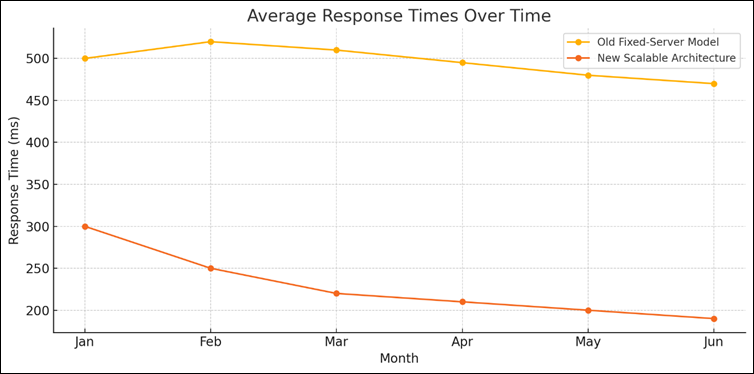
The system handles 8× more than normal traffic with zero downtime and maintains a minimal response time of under 300ms during peak holiday promotions.
✔️ 30% Cost Reduction
We saved cost with pay-per-use pricing and by eliminating a fixed stack of servers.
✔️ 100% Faster Feature Releases
Their new microservice based setup allowed quick deployment of function, without affecting the entire system.
✔️ 99.99% High Availability
Achieved 99.99% uptime since launch, with failovers automatically handled by AWS services.
✔️ 100% Improved User Experience
The reduced site slowdown has boosted the overall user experience and revenue.
Visualizing Success

Key Learnings
This implementation reinforced the value of adopting a serverless architecture, as it enables immediate elasticity and seamless handling of peak traffic surges. It also highlighted how logs and distributed traces play a critical role in debugging microservices and maintaining consistent performance across the system. By offloading common responsibilities such as authentication and database scaling to managed services, the team was able to dedicate more time and focus to core business logic and innovation. Finally, the experience emphasized that clear and continuous communication between business stakeholders and technical teams is essential to ensure alignment, reduce friction, and support a smooth transition throughout the implementation process.
Future Outlook
Looking ahead, we plan to strengthen our analytics capabilities by configuring serverless data pipelines using Amazon Kinesis and Amazon Athena. This setup will enable real-time data ingestion and scalable querying, providing deeper insights into user behavior, interaction patterns, and preferences. These insights will help drive more informed decision-making, continuous optimization of AI responses, and a more personalized user experience.