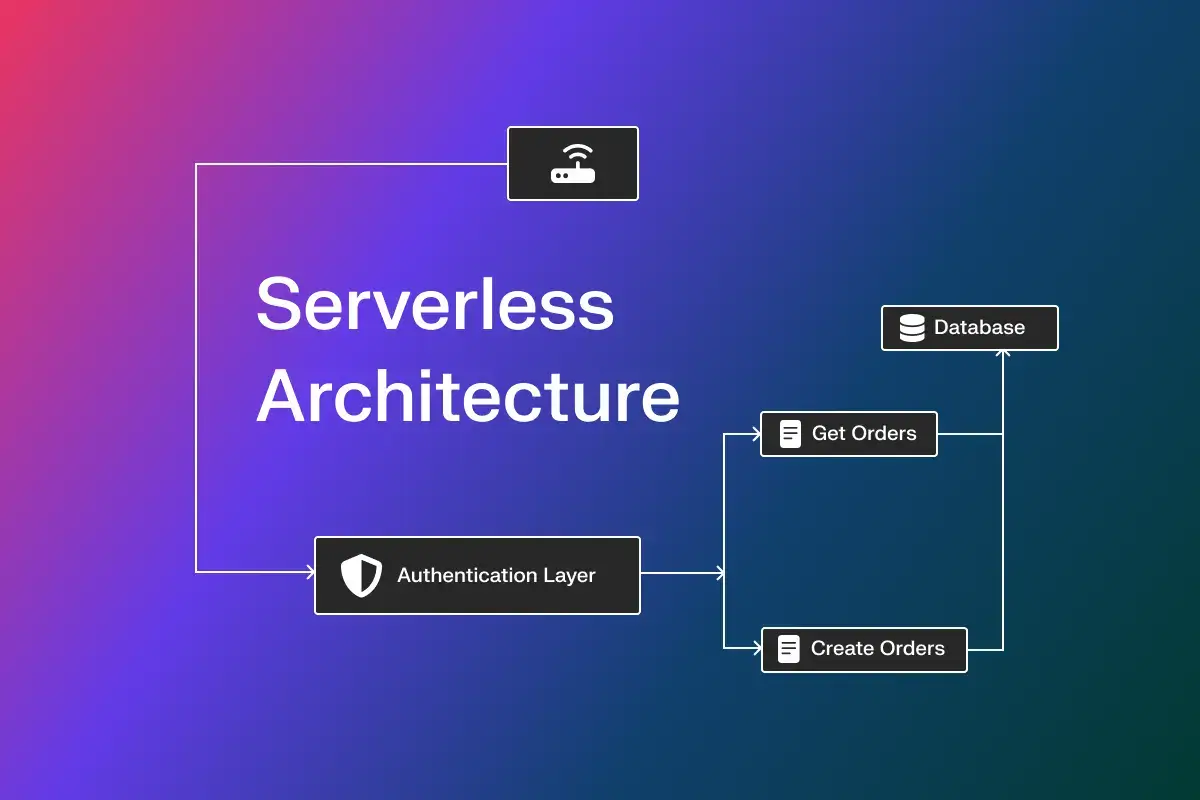
Imagine a scenario: You are running an online Tour Booking Site (for tours, events or travel bookings). Production traffic is manageable most of the time. But suddenly, one of your tour deals gets hyped for some reason and within a minute your site is overloaded with eager customers. This can overwhelm traditional server-based systems. And it also causes trouble for companies which results in low loading times, crashes, and frustrated users.
Here comes the Serverless Architecture in the scenario. It’s a modern cloud approach that takes care of server infrastructure by-self and works behind the scenes. This way developers can do work on writing code not on managing servers. In this blog, we’ll explore what serverless architecture is, why it’s a game-changer for booking platforms, which AWS services fit this model, how to design it well, and challenges you should take care of in Serverless Architecture.
What is Serverless Architecture?
“Serverless” doesn’t literally mean “no servers exist”. It simply means you are not the one who manages the servers and related infrastructure. In Serverless Architecture, your cloud provides (like AWS) allocates servers and handles them by scaling up and down automatically— so you don’t have to do it. You simply deploy your code of functions or services, and cloud providers run that on-demand, and automatically scales up when needed and scales down (even to zero) when not in use.
In this, you pay only for resources you use in the time duration. This is most likely useful for booking platform type services where most users book in the daytime and not much traffic happens after midnight. With Serverless Architecture, you don’t have to pay for idle servers during the quiet time of the platform and you also don’t have to manage servers during the peak time of the platform. This way it provides Elastic Scalability and Cost Efficiency both. It is also very easy in Serverless Architecture to deploy your resources in different regions around the world. This way every user will be able to get a fast response without any delay or latency issue. And this also makes your data and functions highly available across multiple availability zones by default.
Key AWS Services for a Serverless Booking Platform
While there are many cloud providers, AWS is a popular choice with a range of serverless-friendly services. Here are some of its basic overviews,
AWS Lambda
It is used to run your code on-demand. In this you have to create small single-purpose functions that get invoked when needed. Lambda automatically runs the code whenever it gets triggered by an event or API call, and then also shuts it down. By this way, it only bills you for the seconds of execution time. Lambda can scale from zero to thousands of concurrent executions if needed, so it can easily handle high booking requests during a peak period.
Amazon API Gateway
It works as a front door for your APIs. It allows you to define RESTful endpoints for your services. Clients call an HTTP endpoint (like /getTours or /createBooking) and API Gateway routes the request to the appropriate Lambda function. API Gateway would expose all the necessary backend APIs to the front-end which enables users to search tours or make bookings via standard HTTP calls. It also handles routing and security related authorization and authentication mechanisms.
Amazon DynamoDB
It is a fully managed serverless NoSQL database service. It can handle extremely high request rates with low latency and scales up or down automatically according to traffic. It is perfect for storing data such as tour details, user profiles, bookings/reservations, and inventory counts.
Amazon S3
It is used to store file and static assets (images, PDFs, etc.) with near-infinite capacity. You can also host your entire front-end (HTML, CSS, and JavaScript) on S3, then serve it globally via AWS CloudFront for speed and reliability.
Amazon CloudWatch
It is used to monitor usage and performance of the application and its services. All AWS Lambda function logs are automatically sent to CloudWatch Logs, where you can view them to debug issues. You can set alarms for instant high or low traffic spikes to analyse your system’s behaviour in real time.
Common Challenges & How to handle them in AWS Services
Serverless architecture indeed brings many benefits but it’s not without its challenges. It’s important to be aware of potential issues that can arise and approaches to mitigate them, especially in a high-stakes application like a booking portal.
Cold Start Delays
- When a Lambda function hasn’t been invoked for a while, it experiences a cold start, causing a slight delay.
- A cold start occurs because AWS needs to:
– Arrange a new container.
– Load your code into the container. - This delay can impact user experience in systems like a booking portal.
- Mitigation strategies:
– Use languages with faster startup times, e.g., Python instead of Java or C#.
– Implement a “warm-up” mechanism: Periodic invocation (e.g., ping the function every 5 minutes) and Schedule invocations during business hours to keep the Lambda function warm.
Execution Time Limits
- AWS Lambda has a maximum execution time of 15 minutes per function.
- Most operations in a booking portal (e.g., search queries, booking writes) complete within seconds.
- Long-running tasks (e.g., generating complex reports, syncing large data sets) may exceed this limit.
- Mitigation strategy:
– Break large tasks into smaller chunks.
– Process the chunks in batches to stay within the time limit.
Dependency on Vendor/Service Limits
- Serverless services have default limits, e.g.:
– AWS allows 1,000 concurrent Lambda executions per region by default.
– API Gateway has limits on requests per second. - A sudden traffic spike can exceed these limits if not configured properly.
- Load testing is essential to:
– Identify bottlenecks.
– Validate service limits under expected load. - Mitigation strategy:
– Increase Lambda concurrency limits if high load is expected.
– Implement defensive measures: Throttling (e.g., API Gateway rejects excess requests) and Queueing (to handle traffic without overloading services).
Debugging and Complexity
- Serverless architectures introduce complexity due to many moving parts (e.g., multiple Lambdas, events, queues).
- Debugging becomes more difficult compared to a single monolithic server.
- It can be challenging to trace failures across components.
- Mitigation strategies:
– Implement good logging practices.
– Use unique identifiers in logs to trace individual requests.
– Enable distributed tracing using tools like: Amazon X-Ray, OpenTelemetry
– These tools help with system instrumentation and monitoring.
Scalability in Action:
One of the true tests of a serverless booking system is how it handles traffic spikes. Imagine your booking site normally handles around 50 requests per second. But thanks to that hyped tour deal, traffic jumps to 500 requests per second (ten times the usual load) within a few minutes.
Handling Traffic Spikes
In a traditional setup (Server-Based Architecture), your servers could get overwhelmed if you haven’t planned for that capacity. Users would experience slow responses or even errors as servers max out CPU or run out of database connections.